If you've ever stared at a molecular structure in a textbook or research paper and felt lost, you're not alone. Chemical diagram symbols are the visual language of chemistry and learning them is like learning the alphabet before reading a book. Without understanding what each symbol means, you can't accurately read reactions, predict products, or communicate your own findings. This guide breaks down the symbols you'll encounter in chemical diagrams, explains what they mean, and shows you how to use them correctly in your own work.
What do the symbols in chemical diagrams actually represent?
Chemical diagrams use a set of standardized symbols to represent atoms, bonds, electron movement, charges, and molecular geometry. Each symbol carries a specific meaning that chemists worldwide agree on. For example, a single line between two atoms represents a single covalent bond, while a double line represents a double bond. A dashed wedge indicates a bond going behind the plane, and a solid wedge means a bond coming toward you in three-dimensional structural formulas.
These symbols aren't arbitrary. They follow conventions set by organizations like IUPAC (International Union of Pure and Applied Chemistry), which standardizes chemical nomenclature and notation so that a chemist in Japan can read the same diagram as a chemist in Brazil and draw the same conclusions.
What are the most common bond symbols in molecular structures?
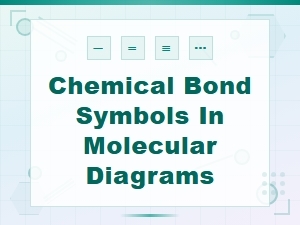
Bond symbols are the backbone of any chemical diagram. Here's what each one means:
- Single line ( ): A single covalent bond sharing one pair of electrons (e.g., the C–C bond in ethane).
- Double line (=): A double covalent bond sharing two pairs of electrons (e.g., the C=O bond in acetone).
- Triple line (≡): A triple covalent bond sharing three pairs of electrons (e.g., the N≡N bond in nitrogen gas).
- Solid wedge (▶): A bond coming out of the plane toward the viewer, used in stereochemistry.
- Dashed wedge (▷ with dashed lines): A bond going behind the plane, away from the viewer.
- Wavy line (~): A bond where the stereochemistry is unknown or a mixture of configurations.
- Dotted line or dashed line (---): Sometimes used to represent hydrogen bonds or partial bonds.
If you want a deeper dive into each of these, our guide on bond symbols in molecular diagrams covers them with more structural examples.
Why do chemists use arrow symbols, and what do different arrows mean?
Arrows in chemistry aren't just decorative. Each type communicates a specific action or relationship between molecules.
- Full reaction arrow (→): Shows a chemical reaction proceeding from reactants to products.
- Equilibrium arrows (⇌): Indicates a reversible reaction where both forward and reverse reactions occur.
- Resonance arrow (↔): Shows that two or more structures are resonance contributors of the same molecule not different reactions.
- Curved arrows (↷): Used in reaction mechanisms to show the movement of electron pairs from nucleophile to electrophile.
- Fish-hook arrows (↝): Represent single-electron movement, commonly seen in radical reactions.
A very common mistake is confusing the resonance arrow (↔) with the equilibrium arrow (⇌). They look similar but mean completely different things. A resonance arrow does not mean the molecule is flipping back and forth between two forms it means the real structure is a blend of the drawn contributors. You can read more about this in our reaction mechanism arrow symbols reference.
What do charges and lone pairs look like in chemical diagrams?
Formal charges appear as superscript plus (+) or minus (−) signs next to an atom. For instance, a nitrogen with four bonds and no lone pairs carries a positive formal charge (N⁺). An oxygen with three lone pairs and one bond carries a negative charge (O⁻).
Lone pairs pairs of valence electrons not involved in bonding are shown as two dots beside an atom (∶). Some diagrams omit lone pairs to keep things clean, but in mechanism work, they're often drawn explicitly because they're the electrons doing the reacting.
What do the symbols in structural formula types mean?
Chemists use different levels of detail depending on the context:
- Full structural formula: Every atom and every bond is drawn out, including hydrogen atoms attached to carbon.
Groups like CH₃ or OH are written in text without drawing every bond line. - Skeletal (line-angle) formula: Carbon atoms are implied at each corner and endpoint of a zigzag line. Hydrogens on carbon are not drawn you infer them based on carbon's four bonds. Heteroatoms (O, N, S, etc.) are always written out.
- Lewis structure: Shows every atom, bond, and lone pair explicitly. Often used for small molecules and in general chemistry courses.
Skeletal formulas are the standard in organic chemistry research papers and textbooks. If you're new to them, a good starting point is understanding that each bend and endpoint in the zigzag is a carbon with enough hydrogens to complete its four bonds.
For the official conventions on how these diagrams should be drawn, our guide to IUPAC chemical structure diagram notation breaks down the rules step by step.
When would I actually need to know these symbols?
You'll encounter chemical diagram symbols in several real situations:
- Reading textbooks and research papers: Almost every organic and biochemistry resource uses line-angle structures and mechanism arrows.
- Solving mechanism problems: You need to draw curved arrows correctly to show electron flow on exams and assignments.
- Working in a lab: Understanding what's drawn on a reaction scheme helps you follow procedures and understand what's happening in a flask.
- Communicating research: If you publish or present, your diagrams need to follow standard notation so others can interpret them accurately.
- Using chemistry software: Programs like ChemDraw, MarvinSketch, and Avogadro use these same symbols, and you need to understand what you're building.
What are the most common mistakes people make with chemical diagram symbols?
Even experienced students make errors that can change the meaning of a diagram entirely:
- Using a resonance arrow when they mean a reaction arrow. Drawing ↔ instead of → suggests the product is a resonance form, not a new substance.
- Forgetting to show stereochemistry. Omitting wedge/dash bonds when stereocenters are present can make a structure ambiguous or wrong.
- Misplacing formal charges. A missing charge on an intermediate can mislead a reader about what's happening in a mechanism.
- Drawing curved arrows incorrectly. Arrows should go from electron-rich to electron-poor regions from a lone pair or bond toward the atom accepting electrons, not the other way around.
- Using inconsistent notation. Mixing IUPAC-style notation with informal shorthand in the same diagram looks sloppy and confuses readers.
- Confusing hydrogen bonds with covalent bonds. Hydrogen bonds are typically shown as dashed or dotted lines, not solid lines.
How can I get better at reading and drawing chemical diagrams?
Start with these practical steps:
- Practice with skeletal structures daily. Convert a few condensed formulas into line-angle drawings each day until it feels automatic.
- Draw mechanisms by hand before using software. Physically drawing curved arrows helps you internalize electron flow patterns.
- Compare your diagrams to textbook examples. Check your work against published structures to see if your symbols match what's standard.
- Learn the IUPAC rules. The conventions aren't just academic they prevent real miscommunication. Understanding proper IUPAC diagram notation gives your work credibility.
- Use flashcards for symbol recognition. Some students find it helpful to make cards with a symbol on one side and its meaning on the other, especially for arrow types.
Quick-reference checklist for chemical diagram symbols
- ✓ Single, double, and triple lines represent one, two, and three shared electron pairs
- ✓ Solid wedges point toward you; dashed wedges point away
- ✓ A reaction arrow (→) ≠ an equilibrium arrow (⇌) ≠ a resonance arrow (↔)
- ✓ Curved arrows show electron pair movement; fish-hook arrows show single-electron movement
- ✓ Lone pairs are drawn as pairs of dots and matter in mechanism work
- ✓ Skeletal structures imply carbons at every corner count hydrogens accordingly
- ✓ Always check that formal charges are drawn where needed
- ✓ Follow IUPAC standards when preparing diagrams for publications or presentations
Next step: Pick a reaction you're currently studying, draw its full mechanism with correct arrow symbols, and verify every arrow flows from electron-rich to electron-poor. If you're unsure about any symbol type, revisit the specific guides linked above for detailed examples and explanations.
 Common Chemical Bond Symbols Used in Molecular Diagrams
 Process Flow Diagram Symbols in Chemical Engineering
 Organic Chemistry Reaction Mechanism Arrow Symbols Guide
 Iupac Chemical Structure Diagram Notation Explained
 Flowchart Connector Symbol Explained: a Complete Visual Guide
 Iso 5807 Standard Flowchart Symbols Quick Reference Guide